

Supplemental Training: Ordering out of Square Glass
Ordering glass from a fabricator is a key
part of every glazing project manager’s job. It can be pretty complicated: you
have to account for the type of glass you need, quantities, sizes, coatings,
thicknesses, edge work, and the list goes on … But it gets even more complicated
when you throw out of square glass into the mix (glass that is neither square
nor rectangular). These out of square pieces can take on all sorts of irregular
shapes, so fabricators need extra information to make them. Simply providing
your fabricator with dimensions isn’t going to cut it. Typically, there are two
ways to order out of square glass:
- You provide your fabricator with a template cut onsite to the exact size of
the pieces required, or - You provide a drawing with all key dimensions clearly marked.
Let’s look at both ordering methods and their associated pros
and cons.
Method 1: Creating a template
Most glass suppliers are equipped with a pattern digitizer or similar equipment
that can take an image of a piece of glass and translate that image into a
digital file that can be input into cutting equipment. Pattern digitizers can
read all sorts of materials, so the template you provide doesn’t necessarily
have to be made from glass. For example, you can provide a pattern made from
cardboard, plywood, thick paper, or any other material, really, that can be
easily cut to the required size. While the material used doesn’t matter,
accuracy does. It’s crucial that the template you provide is dimensioned
properly.
This is a simple and effective way to order out of square pieces because you can
simply check that your template fits the opening that it will fill. If it does,
you know the fabricated glass pieces will too. This method also eliminates the
need to interpret dimensions or notes and the risk of misinterpreting the
drawings. Of course, there are downsides. One of them is that creating a
template can be time-consuming for field crews. Another disadvantage is that
this method only works if you have framing already installed. If you have to
order your glass before the framing is installed, it won’t be possible to create
an accurate template.
Method 2: Ordering from shop drawings
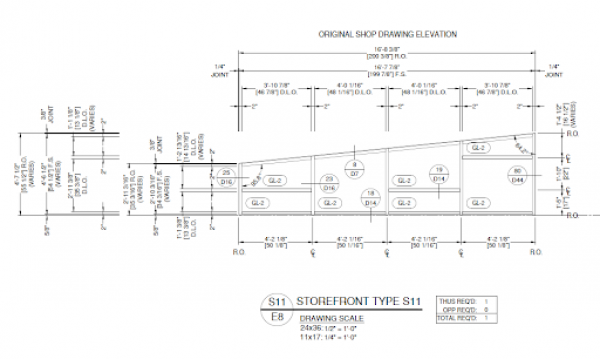
Your drafter will be able to draw any irregular glass shape using AutoCAD
drawings of the elevations as a starting point. The process is pretty simple for
an experienced drafter. First, they’ll need to trace the outline of the daylight
opening (DLO), which is the actual glass size that is visible. Then they’ll
offset those lines by the same amount as the “bite” of the glass, or how far the
glazing is imbedded in the frame. Finally, the drafter dimensions the whole
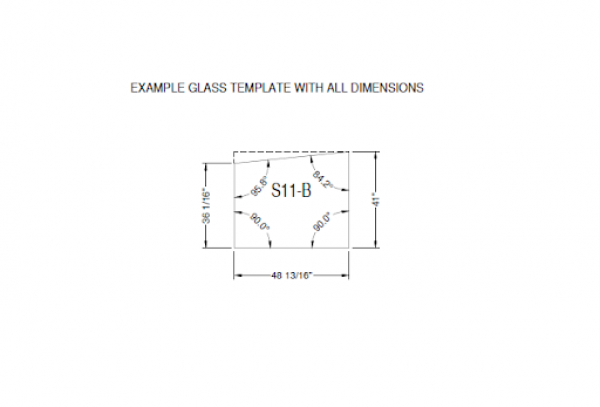
shape of the out of square glass piece. Fabricators need to know the dimensions
of each side and at least two angles. However, it’s best practice to also
include hidden lines that outline the rectangular piece of glass from which the
out of square piece will be cut. The drawing should also include the angles of
all intersecting lines. See below for an example.
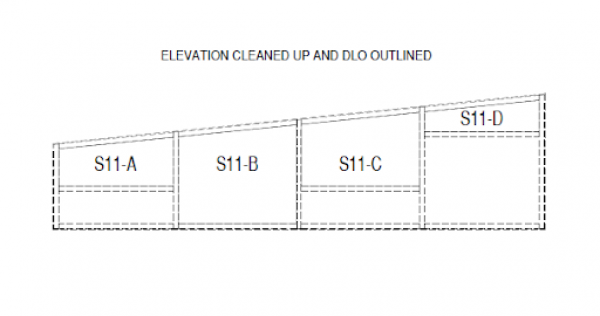
It’s also important for drafters to label every glass piece. This way, your
field crew will know exactly where each piece should be installed. We recommend
labeling drawings with the elevation number as the start of the tag so it can be
easily matched to the opening where it will be installed. For example, for
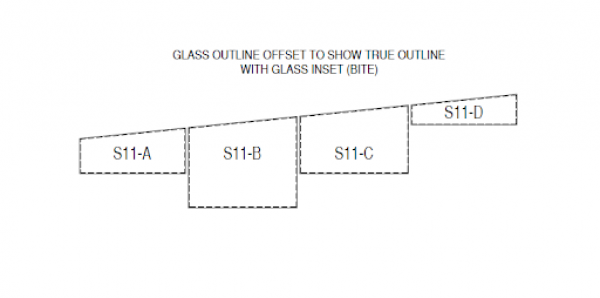
elevation “F”, individual pieces should be tagged as F-1, F-2, etc. The images
below illustrate the process of cleaning up an elevation drawing to create a
template drawing that your fabricator can use to make your out of square glass
pieces.
Which method is best?
Ultimately, the best method depends on your project requirements and also your
preferences. To summarize, here are the pros and cons of both:
Method 1: Creating a template
Pros:
- Saves time in the drafting phase by eliminating the need for detailed
drawings of each piece - A simple and reliable process
Cons:
- Can be time-consuming for field workers, especially if multiple templates
are required - Must have framing installed to create an accurate template
Method 2: Ordering from shop drawings
Pros:
- Can be done at any project stage, allowing you to plan ahead and keep your
project on schedule - Allows you to easily order out of square pieces with a variety of shapes and
dimensions
Cons:
- Can prolong the drafting period and introduce complexity
- Increases (slightly) the potential for errors during fabrication if
dimensions are improperly labeled or read
Questions?
We’re available if you need help with out of square pieces or anything else
related to glass and glazing projects. Just reach out via our
contact page and one of our
experts will be in touch as soon as
possible.