
The Fire Safing Insulation Detail Architects Hand You And Why MP Drafting Never Uses It As-Is
Technical lessons from MP Drafting’s internal training program.

Technical lessons from MP Drafting’s internal training program.
Download the actual MP Drafting internal lesson drawing (PDF) This is the Monday training drawing MP drafters work through, included so you can see how we teach this internally.
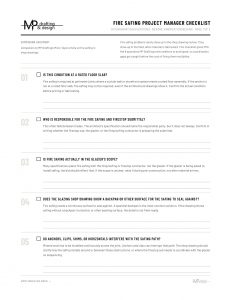
Download The Project Manager Checklist For Fire Safing Coordination
The 9 questions MP uses to catch coordination gaps before fabrication.
Some drafting companies can copy a detail. That does not mean they understand it.
The gray box at the slab edge
Fire safing shows up in nearly every curtain wall and storefront shop drawing package. It is the hatched fill between the back of the system and the floor slab.
Every glazing drafter has drawn it. Most have copied it from the architectural drawings. Some have just thrown a box in because the architecturals showed something there.
That is the problem.
Fire safing insulation is not a graphic. It is a life safety assembly that has to be installed by a real trade, against a real surface, in a real gap. The architectural detail shows design intent. It does not confirm that the actual glazing system, the actual anchors, and the actual slab edge leave room for the safing to do its job.
It may look like a complete detail. It is not yet a buildable one.
Fire safing is also usually not in the glazier’s scope. The firestop or fireproofing sub installs it, and often submits their own shop drawings for it. So it is tempting for a glazing drafter to treat the whole thing as someone else’s problem.
But the glazing system decides whether the fire safing can actually work. Backpans, slab edges, anchors, horizontals, and open framing all matter. When the glazing shops show a condition the safing cannot seal to, the problem lands on the glazing PM anyway.
That is why MP Drafting teaches fire safing as an internal training topic. Not to turn drafters into firestop consultants. To train them to recognize when a detail needs a question before it needs a line.
What fire safing insulation actually is
Strip away the terminology and fire safing is simple. It is a perimeter joint that needs fire protection.
When a curtain wall runs past the edge of a rated floor slab, there is a gap between the slab edge and the back of the glazing system. Fire and smoke do not care that the gap is only a few inches wide. In a fire, that gap is a chimney connecting one floor to the next.
Fire safing insulation closes that chimney. The industry also calls it safing, safing insulation, firesafe insulation, or perimeter fire containment. Architects sometimes lump it under fire safety insulation in specifications. Different names, same job: keep fire and smoke from passing between floors at the perimeter joint.
The three components of the assembly
A working fire safing condition has three parts.
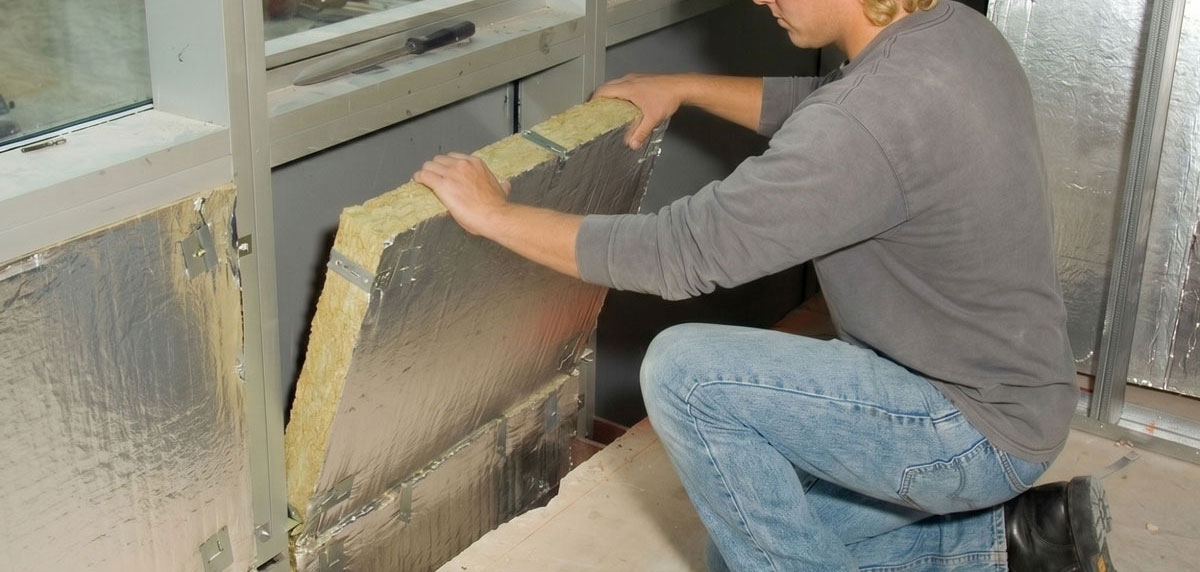
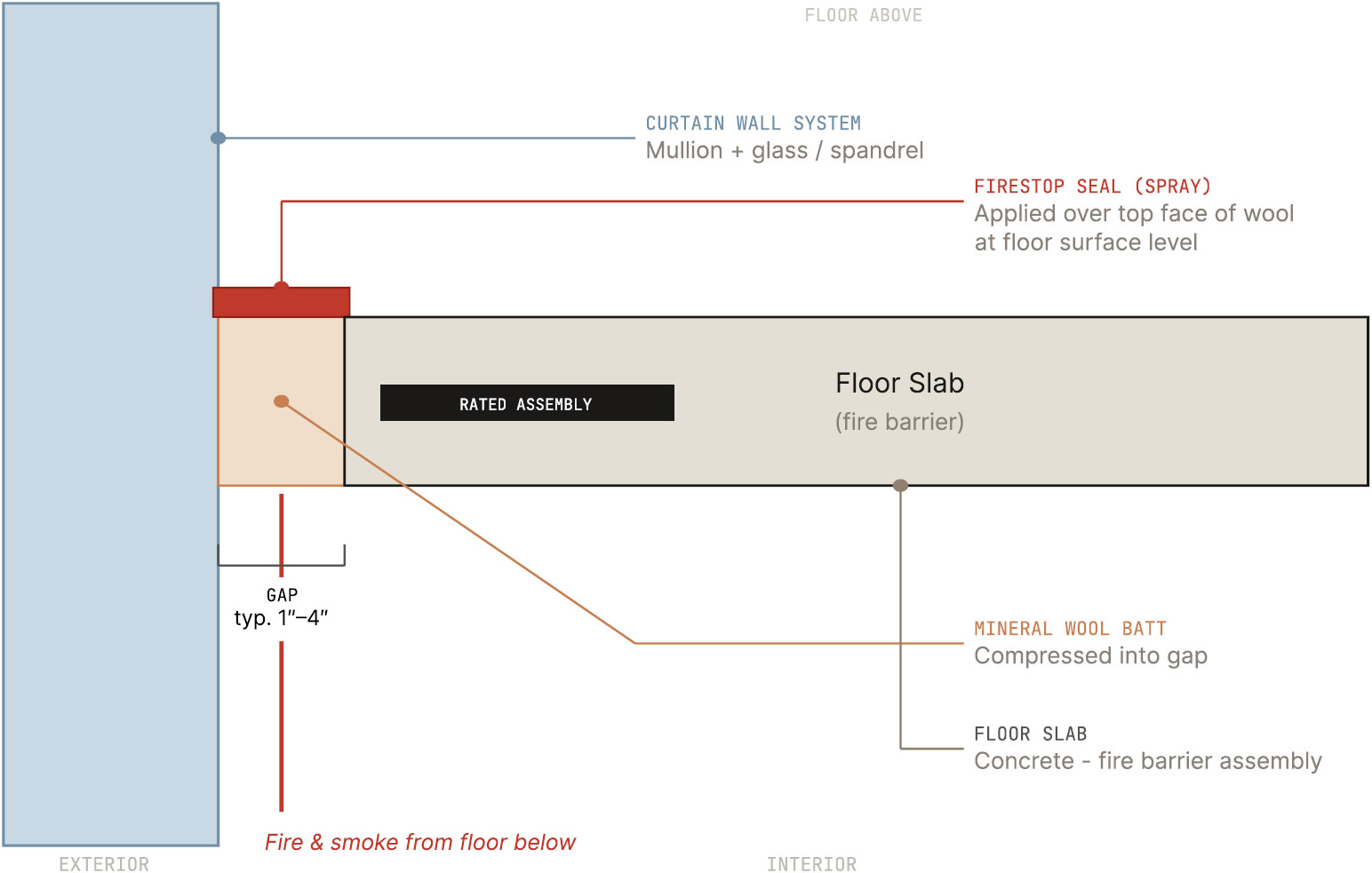
- The safing insulation itself. Mineral wool cut oversized and compressed into the gap between the slab edge and the back of the system. The compression is what holds it in place and what makes it perform. Loose insulation laid in a gap is not safing.
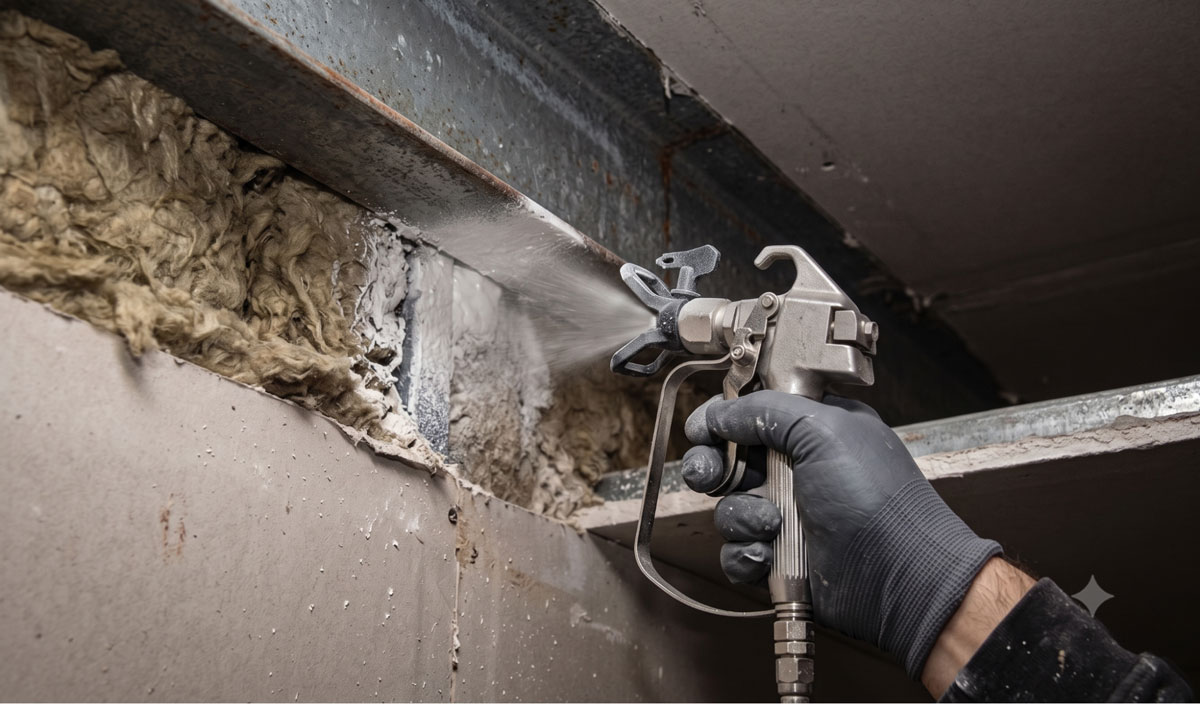
- The smoke seal. A sprayed or troweled sealant applied over the mineral wool. The mineral wool resists fire. The spray seal stops smoke. Smoke movement kills more people than flames, which is why the seal matters as much as the wool.
- A surface to seal against. This is the part where shop drawings go wrong. The safing has to compress against something continuous on the glazing side. A spandrel backpan or foil faced insulation is the most common answer. Without a continuous surface, the assembly has nothing to work against. Listed systems also require the spandrel insulation to be reinforced so it does not bow away from the compressed safing. The backpan is not just a surface. It is part of what keeps the compression working.
It may look like fire safing on the drawing. It is not yet fire protection until all three parts exist in the field.
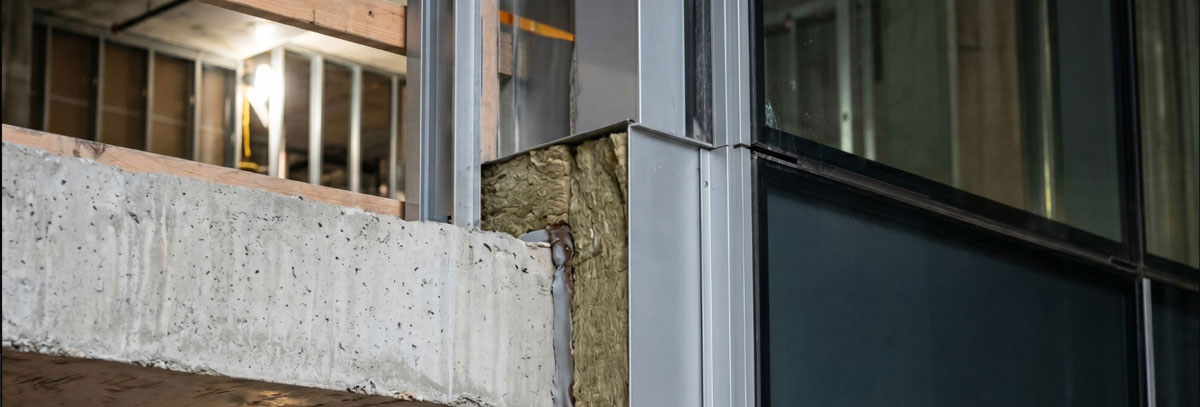
Where fire safing applies and where it does not
Fire safing belongs at perimeter joints where the glazing system passes a rated floor assembly. That is the condition the listed systems are tested for.
It does not belong everywhere the architecturals happen to show it. If an anchor condition is not at a floor line at all, there is no perimeter joint to protect, and fire safing is not required there. As the MT-36 training sheet puts it, there is no point plugging the hole if the smoke has no floor or ceiling to stop it elsewhere. One caution: a floor line that is not rated is not the same as no floor line. The IBC still requires the void at a curtain wall and non-rated floor intersection to be sealed with an approved material to slow fire and smoke between stories. It just does not require a full tested perimeter system there.
Copying safing into a condition with no floor line at all does not make a project safer. It makes the drawings wrong in a different direction, and it can create pricing and scope confusion for material nobody needs.
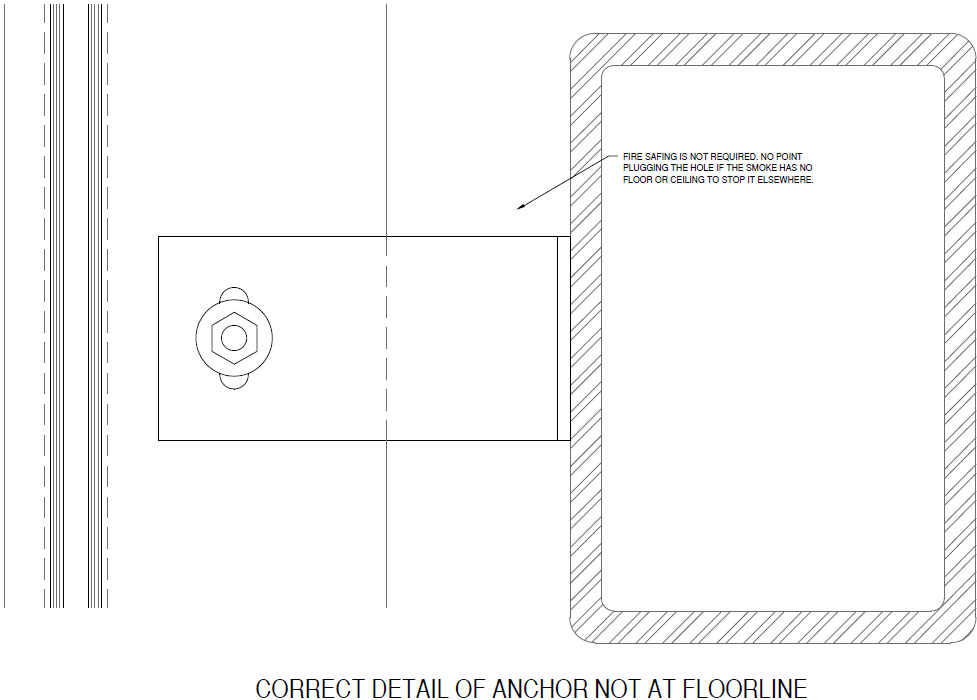
Why MP teaches this internally and what we teach
Every Monday, MP Drafting trains the drafting team on a technical topic. MT-36 is the fire safing session.
The session is not about memorizing a detail. It is about understanding what the detail is trying to solve, so the drafter can recognize when the version in front of them does not solve it.
The default detail is a starting point
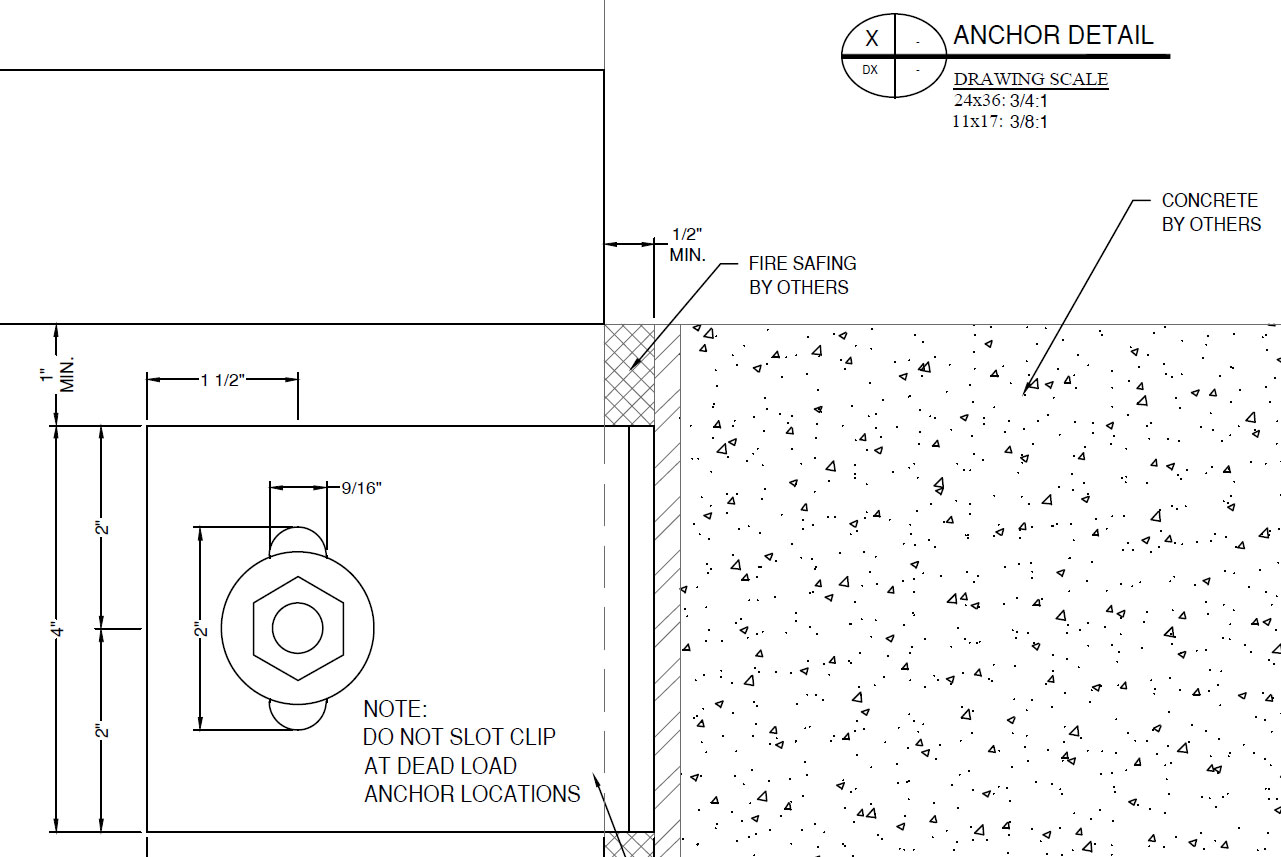
MT-36 starts with MP’s own internal default anchor detail. It shows a dead load anchor at a slab edge with fire safing called out, by others, between the system and the concrete.
The lesson is direct: this detail is a starting point. It should never be dropped into a project without thinking through how it should be implemented based on the architectural detail it is going into.
Is this anchor actually at a rated floor slab? What does the back of the system look like at this elevation? Is the bay spandrel or vision? Those answers change the detail.
A drafter who is only focused on copying lines may simply redraw what is shown. A trained glazing drafter asks a better question: does this actually work with the system?
The three correct conditions
MT-36 walks drafters through the conditions where fire safing actually works, and what each one requires.
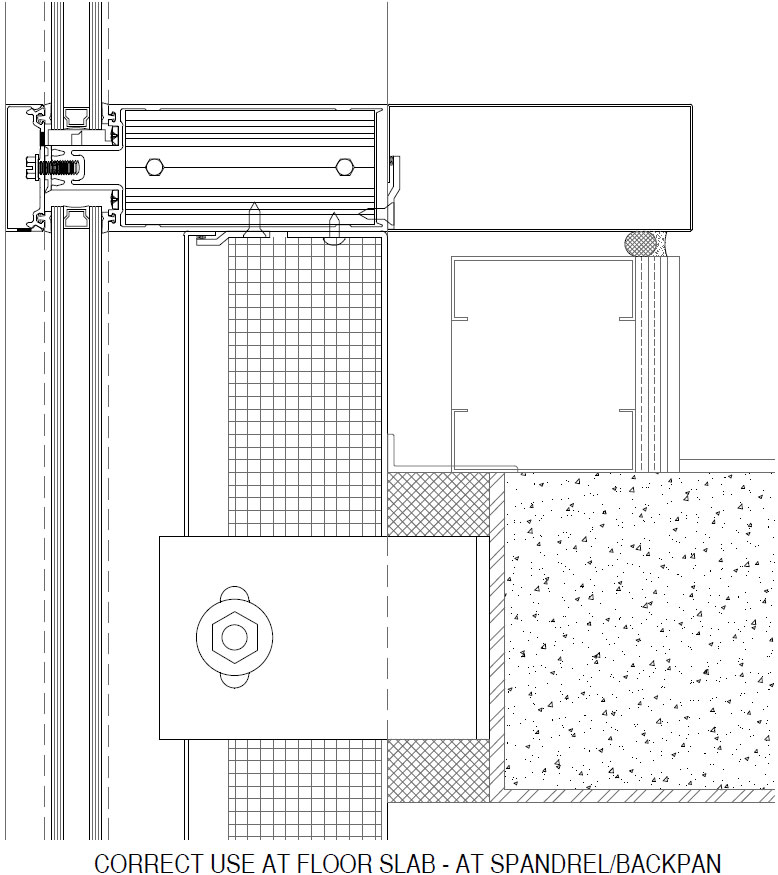
Correct use at the floor slab with a spandrel backpan. The most common solution. The backpan gives the safing a continuous surface to compress against. If the bay is spandrel, the backpan should be there, and the safing detail closes cleanly.
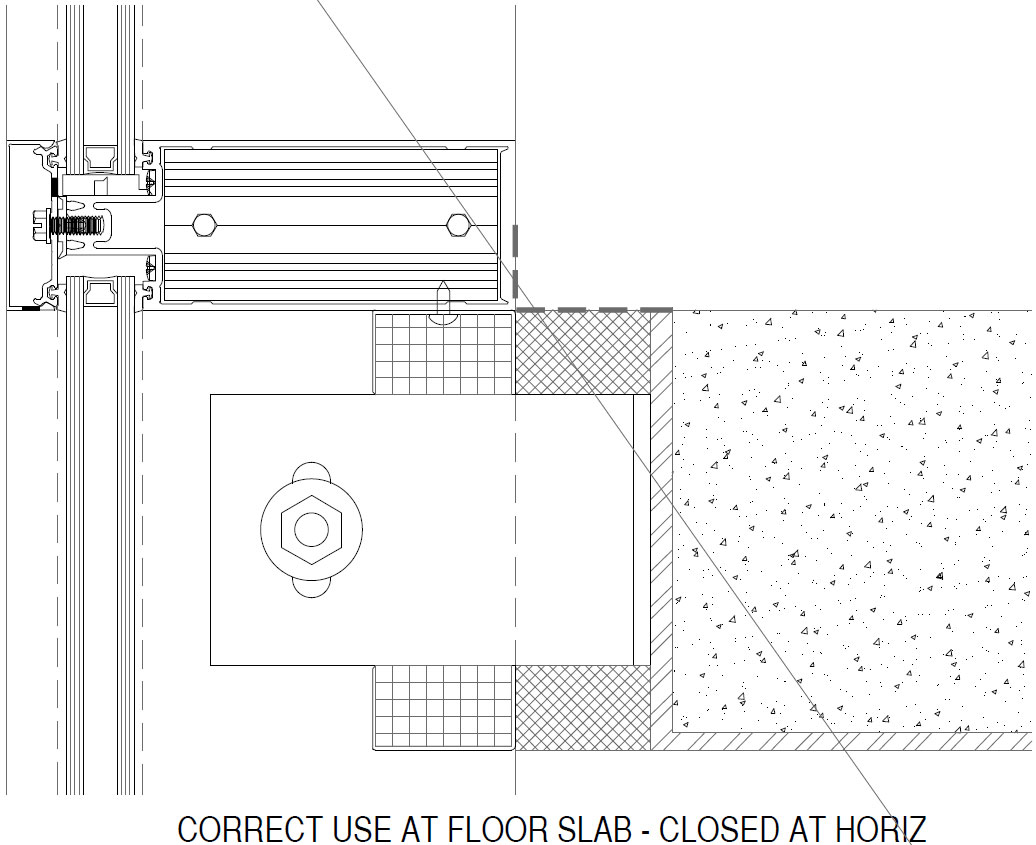
Correct use at the floor slab, no backpan, with a nearby horizontal. In that case, the smoke seal may be applied to the horizontal, depending on the tested assembly and project requirements. A horizontal is not required for safing in general. It is one workable surface when the condition provides it.
Correct use at the floor slab, no backpan and no nearby horizontal. In that condition, the safing may need to be pushed deeper into the system from the glass to create a workable location. Some companies offer a partial backpan at the floor line for a non-spandrel condition, but it blocks part of the bay anyway. Most customers facing that trade-off make the whole bay spandrel instead. Where vision glass runs to the finished floor, the code provides a separate path: the void may be sealed with an approved material rather than a fully tested perimeter system. That is a design decision for the architect and firestop sub, not the drafter, but it explains why some full-vision projects do not show a backpan. it.
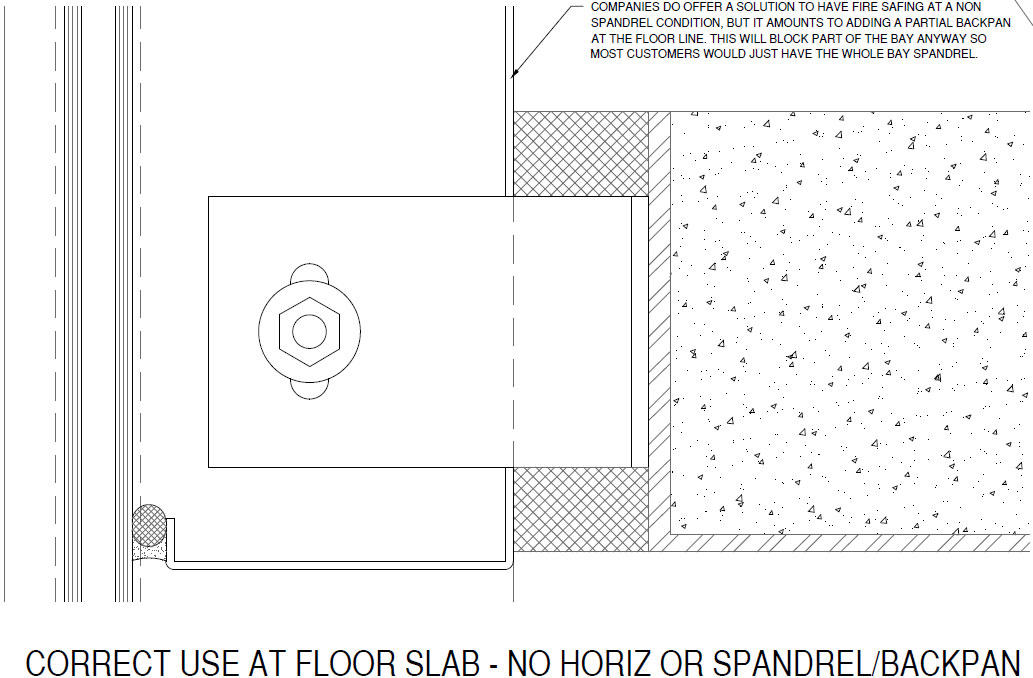
Three conditions. One principle. The safing needs something real to seal against, and the glazing drawings either provide it or they do not.
Recognizing problems, not solving them
Here is the part of the training that matters most, and the part competitors skip.
MP is not designing the firestop system. MP drafters do not select listed assemblies, and they do not make design decisions. That authority belongs to the architect, the firestop sub, and the engineers of record.
What MP trains drafters to do is recognize when something looks wrong and let the people who can make those decisions know. Safing shown with no backpan behind it. An anchor clip sitting in the middle of the safing path. Fire safing is drawn at a condition that is not at a rated floor line. Each of those is a flag the drafter raises to the PM, and the PM raises to the right party, before fabrication.
That is the whole job. Catch it at the desk, hand it to the people who can fix it.
What it costs when nobody catches it
Picture the alternative. The shops get approved with safing drawn against open framing. Material gets fabricated. The wall goes up.
Then the fireproofing sub shows up to install safing and finds nothing to install it against. They stop. The GC calls the architect. The architect asks why the glazing shops showed a condition that does not exist. An RFI gets written, a backpan gets designed after the fact, and the schedule slips while everyone argues about whose scope the fix lives in.
That is the real cost of a copied detail.
Fire safing vs firestop vs fire barrier vs fireblocking
These terms get mixed together in specifications, submittals, and search results. They are not the same thing. A drafter who knows the difference reads the spec correctly. A PM who knows the difference assigns scope correctly.
Fire safing vs firestop
Firestop is the umbrella category. It covers every product and system that seals openings and joints in rated construction, from pipe penetrations to head-of-wall joints. Fire safing is one specific firestop application: the perimeter joint between a floor slab and an exterior wall system, packed with mineral wool and sealed.
All fire safing is firestopping. Most firestopping is not fire safing. When a spec says “firestop submittal,” the perimeter safing is usually inside that package, but confirm it rather than assume it.
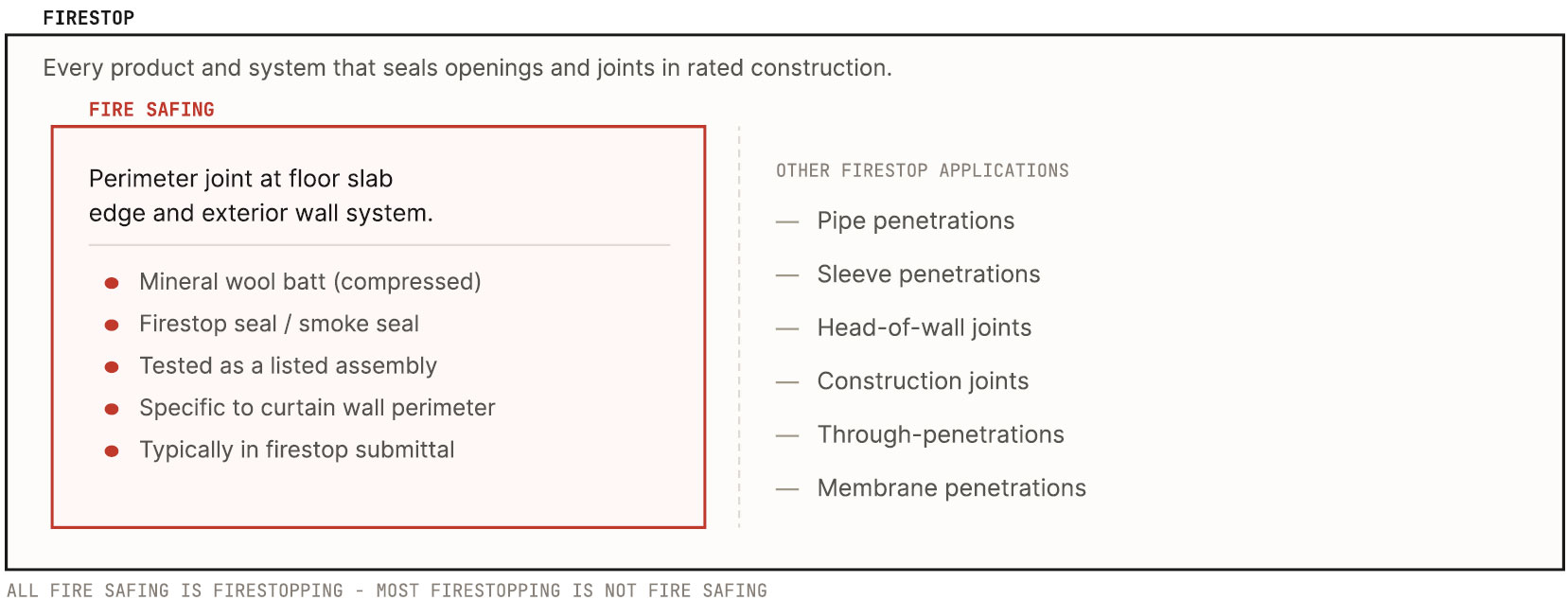
What a firestop seal is
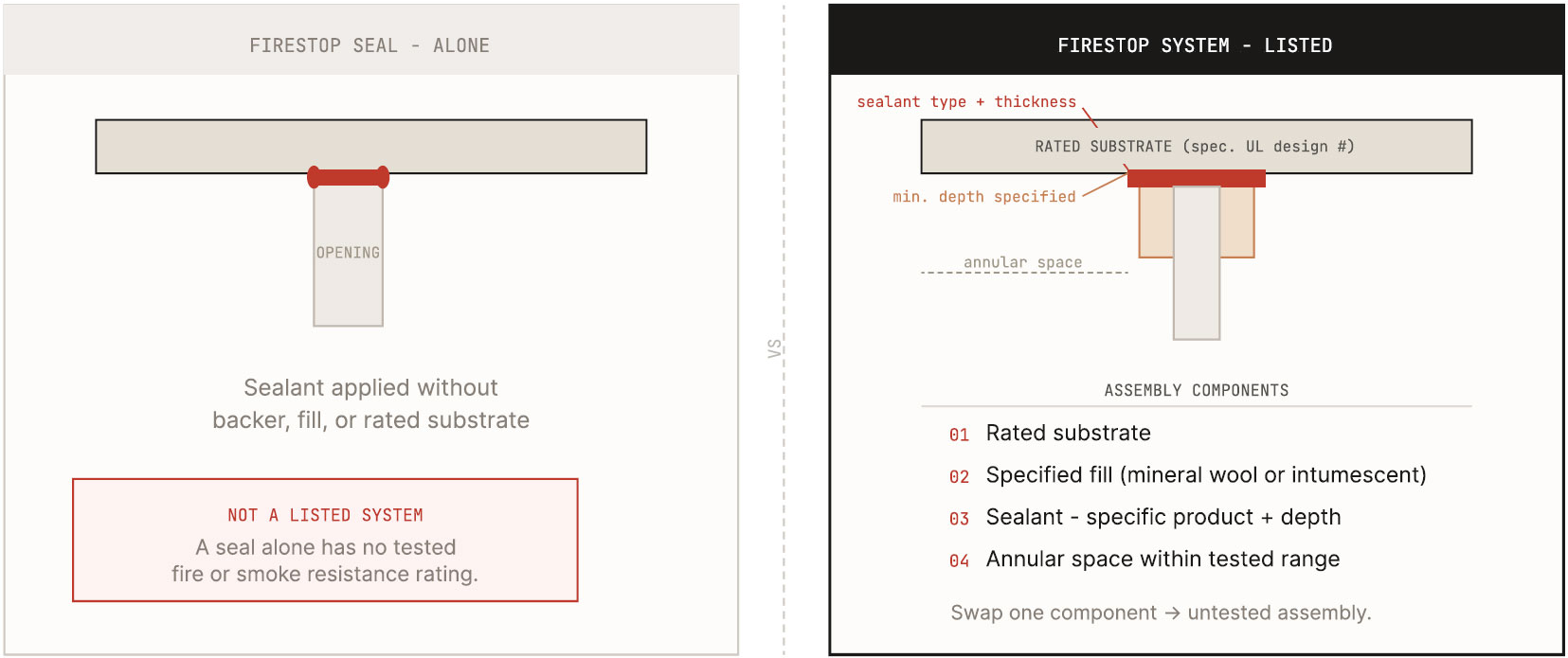
A firestop seal is the sealant component of a firestop system. At a safing joint, it is the spray-applied (sometimes other methods) smoke seal over the mineral wool. On its own, a firestop seal is not a system. Firestop systems are tested as complete assemblies, with specific materials, depths, and compression. Swap one component and the assembly is no longer the one that was tested.
It may look like an equivalent product. It is not yet a listed system.
What a fire barrier is
A fire barrier is a rated wall assembly; rated floors are its horizontal equivalent, what the code calls a horizontal assembly. Either way, it is the construction that resists fire for a rated duration. The slab in the safing detail is part of a fire barrier. The safing exists to continue that barrier’s rating across the joint where the barrier meets the glazing system. The barrier is the wall. The safing is the seam.
What a fire barrier is
Fireblocking is a residential and light-frame concept. It is material, often wood blocking or unfaced batts, installed inside concealed framing cavities to slow fire spread within the cavity. It is prescriptive, not tested as a system, and it has nothing to do with curtain wall perimeter joints. If a commercial glazing spec says fireblocking where it means fire safing, that is worth a clarification, because the two are reviewed and inspected differently.
ASTM E2307: the standard behind the detail
Perimeter joint systems are not judged by how they look in section. They are judged against ASTM E2307, the Standard Test Method for Determining Fire Resistance of Perimeter Fire Barriers Using Intermediate-Scale, Multi-story Test Apparatus. The International Building Code, Section 715.4, requires the void between a rated floor and an exterior curtain wall to be sealed with an approved system tested to ASTM E2307, with an F-rating at least equal to the rating of the floor.
E2307 is not a furnace test of a flat sample. It is a two-story rig with the actual curtain wall construction in place, fire exposure from the floor below, and the wall deflecting and deforming the way it would in a real fire. The system has to hold its seal while the wall moves.
F-rating. The duration the assembly remains intact and prevents flame passage. A 2-hour F-rating means no flame passes through the joint for 2 hours of test exposure.
T-rating. The duration before the temperature on the non-fire side rises a defined amount above ambient. Flame is not the only hazard. A joint can block flame while conducting enough heat to ignite material on the floor above.
L-rating. An air leakage measure tied to smoke movement, expressed in CFM per linear foot of joint, evaluated under UL 2079, the joint-system standard that also covers movement cycling. This is the rating the spray smoke seal exists to earn.
Why does a drafter care? Because the ratings belong to the tested assembly, not to the materials. The listed system assumes a specific joint width, a specific compression, and a specific backing surface. When the glazing shop drawing changes the geometry, the tested assembly may no longer apply. The drafter cannot fix that. The drafter can flag it.
Sources: ASTM E2307, ASTM International. IBC Section 715.4. UL 2079, UL Solutions.
Why MP teaches this internally
Every Monday, MP Drafting trains the team on technical topics like this one.
Fire safing is a simple training example of a much bigger subject: rated-condition coordination. Fire-rated glass, rated framing, listed assemblies, adjacent wall conditions, hardware, sealants, and inspection requirements all follow the same logic. The default detail is a starting point, and the drafter’s job is to notice when the project condition and the detail disagree.
Other Monday training topics include:
- Vapor barrier interaction with glazing systems
- Curtain wall splice joints
- Fastening limitations at brick lintels
- Inside vs outside set storefront
- Shims at storefront and curtain wall framing
- SSG versus captured curtain wall
- Mullion placement based on architectural dimensions
- Fire-rated glazing systems and listed assemblies (coming soon)
These are not random lessons. They are the details that show up in real projects, on real schedules, with real inspectors.

That is what this all comes back to. Good shop drawings should do more than get approved. They should help protect the project from bad assumptions, unclear details, field confusion, and preventable delays. That is why MP Drafting trains drafters differently. We are not just producing sheets. We are building technical judgment into the people behind them.
Take the checklist to your next project
The thinking in this article matters because it shows up on real projects. The PM Checklist condenses the coordination questions a project manager should be asking before fabrication begins.
Nine questions. One page, front and back. Print it, take it into the coordination meeting, and write on it.
It covers scope, submittal responsibility, backpans, anchor interference, and the conversation with the firestop sub that should happen before material is ordered, not after the wall is up.
Need a drafting partner that catches rated conditions before they cost you?
Built for glazing contractors, project managers, and estimators who need drawings that are clean, coordinated, and field-ready.
MP Drafting trains every drafter to think beyond the lines, so coordination problems get caught at the desk instead of in the field. Fire safing is one example. The same judgment shows up in every anchor detail, every spandrel bay, and every rated condition MP draws.
Send the set. MP will tell you what it sees.
Frequently asked questions about fire safing
What is fire safing insulation?
Fire safing insulation is mineral wool compressed into the perimeter joint between a rated floor slab and the back of an exterior wall system, such as a curtain wall. Combined with a spray-applied smoke seal, it prevents fire and smoke from passing between floors at the slab edge. It is part of a tested perimeter fire containment system, not a loose-fill material.
Is fire safing the same as firestopping?
No. Firestopping is the broad category covering all sealed openings and joints in rated construction, including pipe and cable penetrations. Fire safing is one specific firestop application: the perimeter joint where a floor slab meets an exterior wall system. All fire safing is firestopping, but most firestop work is not fire safing.
Where is fire safing required?
Fire safing is required at perimeter joints where an exterior wall system, such as curtain wall or storefront, passes a rated floor assembly. It is not required at conditions away from floor lines entirely. At a floor line that is not fire-rated, code still requires the perimeter void to be sealed with an approved material to limit fire and smoke spread, but a fully tested perimeter fire containment system is not required. Showing safing where no floor assembly exists adds cost and scope confusion without adding fire protection.
Who installs fire safing on a commercial project?
Usually a firestop or fireproofing subcontractor, not the glazier. Specifications often note fire safing as “by others” on glazing drawings. The responsible party should also prepare the firestop submittal. Because specs do not always name that party clearly, responsibility should be confirmed in writing during pre-construction.
What is safing insulation made of?
Safing insulation is mineral wool, a dense fiber insulation spun from rock or slag that withstands temperatures of roughly 2,000 degrees Fahrenheit without melting. It is cut oversized and compressed into the joint, typically around 25 to 33 percent, so friction holds it in place and the density blocks flame. writing during pre-construction.
What standard governs fire safing at curtain walls?
ASTM E2307, the test standard for perimeter fire barrier systems, referenced by IBC Section 715.4. It tests the complete joint assembly in a two-story apparatus with the curtain wall in place. Systems earn an F-rating for flame and a T-rating for temperature rise. L-ratings for air leakage tied to smoke movement come from UL 2079, the standard for building joint systems, which also covers movement cycling.
Does fire safing need a backpan?
Fire safing needs a continuous surface to compress against, and a spandrel backpan is the most common one. Depending on the tested assembly, a nearby horizontal can receive the spray seal, or the safing can be located deeper in the system. A drawing showing safing against open framing with no backing surface is not field-ready.
What is the difference between a fire barrier and fireblocking?
A fire barrier is a tested, rated wall assembly, and a rated floor is its horizontal equivalent. Both are construction that resists fire for a rated duration. Fireblocking is prescriptive material, common in light-frame construction, that slows fire spread inside concealed cavities. Fire barriers are rated systems in commercial construction. Fireblocking is not, and it does not apply to curtain wall perimeter joints.
Use Education to Get Ahead
Every missed deadline creates a ripple effect. Delayed fabrication, wrong orders, wasted time in the field. One way to cut that risk is by training your team to review drawings effectively.
LearnGlazing’s Shop Drawing Course makes it easier to spot issues before they become emergencies. Explore the course.
 Take the Course for Free