What Sealant Continuity Actually Means in Storefront and Curtain Wall
A detail can look correct on its own and still create a field problem.
That is part of what makes shop drawing review difficult. A PM might look at a head detail, a jamb detail, and a sill detail one at a time and feel like everything is covered. But installers do not experience those details one at a time. They have to make them work together around the frame.
That is where sealant continuity matters.
In one of MP Drafting’s internal micro lessons for the drafting team, the point is laid out plainly: the “primary sealant” beads and any “secondary” or aesthetic beads should be shown in the same location across perimeter head, jamb, and sill details. As the installer works around the frame, those sealant beads have to “marry” together at the corners. If the locations do not line up, it becomes difficult or impossible to make a continuous line of sealant, and the frame can leak. Page 1 of the micro topic shows this using matching head, sill, and jamb examples, with the primary seal located consistently relative to the frame face.
That is not a drafting nicety. That is field coordination.

Why continuity matters more than it looks like on paper
A lot of detail review problems come from looking at sheets in isolation.
- Each detail might be technically readable.
- Each note might look normal.
- Each section might seem complete.
But if the seal line shifts from one condition to the next, the installer is left trying to solve the mismatch in the field.
That is the important idea here. Sealant continuity is not about whether sealant exists somewhere on the detail. It is about whether the seal path stays consistent around the perimeter so the building can manage water the way the system intends.
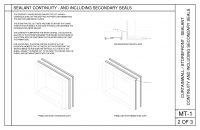
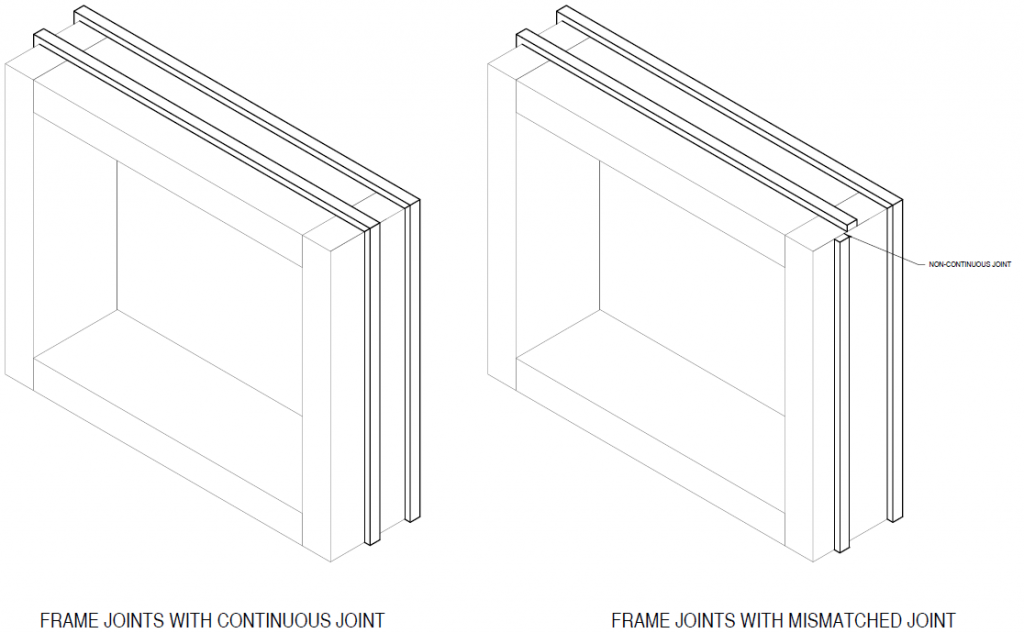
The micro topic makes that point clearly. On page 2, one illustration shows a continuous front joint and another shows a mismatched one where the head and jamb are not aligned. The document calls the mismatched version bad practice, even though it notes that in some situations lining them up may not be possible and the installer may have to bridge the difference with more sealant.
That exception is useful to understand, but it does not change the rule. The rule is continuity.
What the installer is actually trying to do
The installer is not just filling a gap.
They are trying to carry the intended seal around the frame without interruption.
That means the drafter has to think beyond individual detail appearance and ask a more practical question: if someone starts at the head and moves down the jamb to the sill, do these seal locations actually connect in a way that makes sense?
On page 1, the micro topic explains this in direct language. The installer must “marry” the sealant beads at the frame corners together. The lesson also notes that the exact location will vary by manufacturer and system, so the goal is not one universal dimension. The goal is consistency and alignment with the manufacturer’s standard details.
That is a strong review habit for PMs too. When you review a detail page, do not just ask whether the sealant is labeled. Ask whether the seal path is coordinated across the full perimeter.
Storefront and curtain wall do not
manage water the same way
One of the most useful parts of this micro topic is that it teaches more than one lesson.
It does not just say, “keep the seal lines aligned.” It also explains why that matters within each system’s water-management logic.
According to page 2, the continuity of the primary seal is important for water control because its location is meant to stay behind the waterline of the system. The document then distinguishes between curtain wall and storefront. In curtain wall, water control is tied into the horizontal members that receive weeps. In storefront, water is intended to run down the verticals until it reaches the subsill, where it is weeped out. The same page also shows how the subsill and end dam interact with the joint.
That distinction matters because PMs often review details as if all frame conditions behave the same way. They do not.
The shop drawings should reflect the actual water-management strategy of the system being used, not just generic sealant notes.
What a PM should look for during review
You do not need to be the drafter to catch coordination risk early. Here are five good review questions:
- Does the primary seal stay in a consistent location from head to jamb to sill? This is the core question. If the seal line jumps, the installer is being asked to improvise.
- Is there a secondary or aesthetic seal shown, and is it aligned too? Page 1 of the micro topic explicitly says to check both primary and secondary beads for continuity.
- Does the detail follow the manufacturer’s standard logic? The lesson warns that the location varies across systems and manufacturers, so what matters is consistency and alignment with the manufacturer’s standards.
- Is the water-management path clear for this system? If it is storefront, do the details make sense with water running to the subsill and weeps? If it is curtain wall, do the seals and related elements support that system’s intended water control?
- If continuity is not possible, is it noted and escalated clearly? A mismatch should not be hidden. It should be called out.
Reviewing details one sheet at a time? See how MP approaches shop drawing clarity and coordination in our sample sets.
What happens when continuity is not possible
This is where the lesson gets especially useful for PMs.
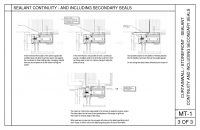
Sometimes the condition does not allow the primary seal to land where it ideally should. Page 3 explains that when the location of the system against the surrounding condition does not allow the primary seal to rest against the membrane or other building water-managing material, there are options to address it without moving the system. One example shown is the addition of flashing that ties into the building membrane so the seal can remain continuous, subject to confirmation. The page also shows a note asking the architect to verify the primary seal where the condition does not allow a continuous seal against the adjacent construction.
That is an important mindset shift.
A good drafter does not quietly force the detail to look cleaner than the condition allows. A good drafter identifies the problem, communicates it, and asks for direction when needed.
The micro topic says this directly: if it is not possible to have a continuous seal at a condition, send an email to the customer to find out whether they want to note it or make a change to allow the joints to line up. It also warns not to change the detail unless directed by the customer.
That is strong coordination discipline.
Scope clarity matters too
There is another PM lesson buried in this micro topic that is easy to miss.
Not every line of sealant shown on a detail is necessarily in the customer’s scope.
Page 3 states that the customer might not be responsible for all lines of sealant at a given system, and that this information can be found in the project specifications or provided during the prep stage of the shops. It also says that what seals are in scope can be conveyed with notes on the detail or with a note on the detail page. The examples shown distinguish between exterior joints by customer and interior joints not by customer.
That matters because shop drawings do more than communicate geometry. They communicate responsibility.
A clean detail page that leaves sealant scope ambiguous can still create a jobsite dispute later.
This is what good shop drawings do
Good shop drawings do not just show parts. They coordinate how the system is expected to work. That includes:
- Where the seal path is intended to run
- Whether that path stays continuous around the frame
- How the water-management logic works in the chosen system
- What is in scope
- What needs customer or architect confirmation before it should be finalized
That is also why drafting should be treated as planning, not drafting-only production.
A PM may never need to draw these details personally. But knowing what to look for changes the quality of review conversations and reduces the chance that a quiet coordination miss turns into a noisy field problem.
A practical takeaway for PMs
Next time you review storefront or curtain wall details, do one simple thing:
Stop looking at head, jamb, and sill details as separate boxes on the page.
Instead, trace the seal path around the frame.
- If it is continuous, that is a good sign.
- If it shifts, ask why.
- If the condition prevents continuity, make sure the note, scope, and escalation path are clear.
That small review habit is the kind of thing many PMs are never formally taught, but it is exactly the kind of issue that separates a clean submittal from a future field headache.
Want drawings that help the field instead of surprising it? Send us a job or review sample drawings to see how MP handles coordination.
Use Education to Get Ahead
Every missed deadline creates a ripple effect. Delayed fabrication, wrong orders, wasted time in the field. One way to cut that risk is by training your team to review drawings effectively.
LearnGlazing’s Shop Drawing Course makes it easier to spot issues before they become emergencies. Explore the course